Tuesday, February 21, 2012

Mae Hong Son

Our senses still reeling from the riot of color and noise that is Bangkok, we said goodbye to Mr. Ving and our driver, Mr. Gong, and left the city for the northern part of Thailand, near the border with Myanmar (formerly Burma). We flew first to Chiang Mai, then boarded a smaller plane for Mae Hong Son. Our transportation for the second leg of the trip was this colorful NOKAIR twin-engine ATR 72 with its nose painted to resemble a beak. When we asked why, we were told that "Nok" means "bird," hence the unusual paint job. 
 

We skimmed the mountain tops and wondered at the smoke from many fires, some set very near the mountain tops. We were told some were associated with logging operations, while others were farmers burning their fields before planting spring crops.  


After an uneventful flight, we swooped down to land on a very short runway in Mae Hong Son. (Fortunately we didn't see just how short it was until later!) Mae Hong Son is a lovely small town, not at all "touristy" in our opinion. 

There is much Burmese influence in this part of Thailand. Not only is Mae Hong Son very close to the Thai border, but the northern region of Thailand has been occupied by the Burmese at several points in its history. The Burmese and Chinese influences in this part of Thailand make it very different from the cosmopolitan atmosphere in Bangkok. 

In the center of town is a lovely small lake and park, and alongside the lake two temples, Wat Jong Kham and Wat Jong Klang.


One is in the traditional Thai style, with tall golden spires. The other is built in the more simple Burmese style. We asked why the small town had two large temples built side-by-side. Apparently two individuals both wanted to sponsor a temple, and so they did.  Never mind that they are so close together that the monks almost trip over one another.  

Inside the temples the decorations are lovely, but lack the splendor of the grand temples in the big cities. The Buddha figures are simpler, as are the murals depicting Buddha's life. All, however, lovely in their own way.


In addition to the traditional Buddha figures, there is a strong influence from the Hindu religion. Just outside the two temples just described we found a shrine dedicated, in addition to Buddha and other deities, to the Lord Ganesha, and the Goddess Durga seated on a tiger.


Our guide for this portion of our trip is Cherngchai Sutabutr. When he met us, he asked us to please call him "Duke." We asked how he got that nickname, because he doesn't at all resemble John Wayne. He replied that 22 years ago, early in his career as a guide, a woman on the tour couldn't pronounce his name, and said that instead she was going to call him Duke. The name stuck.  We are fortunate that Duke grew up in this part of Thailand, and is extremely well-versed on the area and its people.
 
Duke and our driver, Dob, dropped us at our hotel, the lovely Imperial Mae Hong Son Tara Resort. Here is the view from our balcony, and a shot of the outdoor restaurant in the early morning mist.


Mae Hong Son sits in a teak forest, so lovely wood accents are everywhere. The hotel featured lovely hand-carved planters and railings, all made from teak. 

 
The hotel also had a group of resident geckos like this one. Since much of the hotel is open-air, the little critters are everywhere. They're apparently very efficient, though. We saw nary a mosquito while we were there.

Monday, February 20, 2012

Bangkok Back Streets

On one side of our hotel, the Navalai River Resort, is its lovely riverside restaurant and ferry dock.  However, across the street is a whole other world. We took a break from palaces and pagodas to do some exploring there on our own.


We crossed a busy street where colorful taxis careened by at what seemed like breakneck speeds.  (Thank goodness we had been warned that traffic in Thailand does not yield to pedestrians!)


We found ourselves in a maze of narrow alleys lined with small restaurants, vendor stalls and other attractions.   We shared the street with dogs, small children, strolling vendors, shoppers and the occasional vehicle.  Here is what it looks like in the daylight.


At night, the area's character changes. No more casual shoppers strolling by....this is a happening place!   


The bars and restaurants are full, with food preparation taking place in front of many to entice diners. 


Prices were quite reasonable.  The exchange rate was 30 Thai baht to $1.00 US.  So, on the menu above, a nice red snapper dinner would cost $5.00!  Unlike Cambodia, however, all payments are made in the local currency.  It's easy to exchange dollars for baht, but they are not accepted in payment for goods or services. 

Along the street, foot massage parlors like this one are very popular. 


We were also intrigued by the "fish spas," like the one advertised in the image below. They consist of benches where people sit and place their feet in a large aquarium. Apparently the hungry fish nibble away at your feet and legs, producing (one assumes) a tittilating sensation. We took full advantage of spas in Cambodia and Thailand, where a one-hour massage usually cost about $8.  However, we resisted the urge to try out a "fish spa."


We stopped to investigate offerings at several of the food vendor stands. Most featured noodles, egg rolls and grilled meats in several varieties. 


Beer and cocktails were readily available, as well.


The restaurants, however, had full menus, with an emphasis on fresh seafood.  The people-watching was fantastic, and almost anything you could want was for sale.  


We enjoyed our evening outings, but did have to dodge frequent cars and tuk-tuks.   (We found out that, though the "alleyways" were narrow, they could still accommodate vehicles, so pedestrians beware!)

Monday, February 13, 2012

Ayutthaya

Our trip to Ayutthaya on January 16 was packed with palaces and pagodas. We were told that Ayutthaya served as the capital of Siam beginning in the 15th century and continuing until the Burmese invaded in the 18th century.

The first stop on the way to Ayutthaya was at the old royal summer residence. It features buildings in the Thai style, as well as those showing Chinese and Swiss influences.


Not only are the buildings and grounds impressive, there are a number of examples of beautiful wood carvings like these.

After touring the royal summer residence, we took a long-tail boat to Ayutthaya. We again were captivated by sites along the waterways. Tugboats pulling strings of barges, other long-tail boats and smaller personal craft shared the canal with us.


And houses large and small lined the banks. 


Overhead we saw flocks of Asian Openbill Storks. Common in the area, these are huge wading birds with dramatic white and black plumage. We saw them in the rice fields as well.


Arriving in Ayutthaya, we visited three Buddhist temples. The first was Wat Phanachoeng, with this magnificent golden Buddha.

The second, Wat Yai Chai Mongkul, has a large outdoor reclining Buddha and the central tower is completely surrounded by a host of others. We were told that the number of Buddha statues helps to make the lines shorter for those wishing to pray and make donations.


Our last stop in Ayutthaya was at the Wat Mahathat ruins, located in the heart of the city. Built in the 1300s, many of the structures are crumbling. 


However, we saw one of the site's most famous features, a Buddha sculpture that has been almost completely swallowed by a banyan tree. I don't know if there is a complete sculpture under there, or only the head. The literature on site didn't say.


After a morning full of temples and pagodas, John took a short nap in the van en route to where we boarded a cruise ship back to Bangkok.


We enjoyed the trip back to Bangkok, especially the views of the bridge from the deck of the boat.


But upon our return to our hotel, we could no longer resist temptation and opted for a dinner of hamburger and french fries.....our first since leaving Texas! 

Thursday, February 2, 2012

Over The River

Since Bangkok has so many canals and waterways, transportation by long-tail boat is a good alternative to the streets clogged with cars, trucks, tuk-tuks and motorbikes. Following our excursion to the floating market, we took a long-tail boat up the Mae Klong River. 


The river and its system of canals feature many waterfront homes (large and small) and a number of restaurants. 


We were also fortunate to see this somewhat rare water monitor lizard perched on a tree beside the canal.

Though floods covered much of the city late last year, the water has now receded and life has returned to normal. For the most part, the only evidence of the devastation is high-water marks on the buildings and debris caught in the trees. Unfortunately, though, there are also abandoned homes and buildings whose owners lacked the resources to repair them.

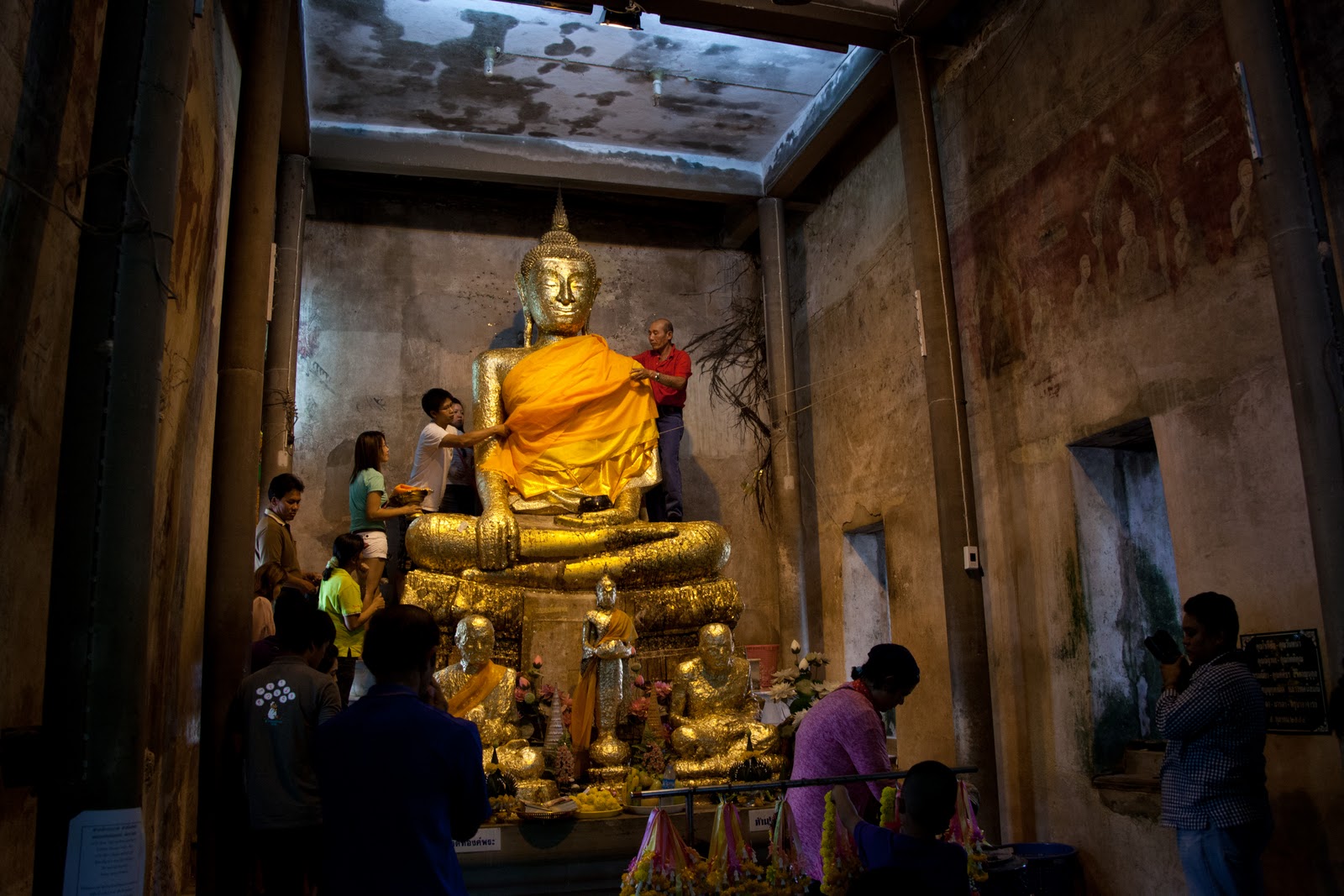
We also visited a couple of temples. One, Wat Bang Kung, features a small chapel completely enclosed within the roots of a banyan tree. You can see the tree roots on the inside walls of the chapel as well as ourside.


That temple site is also home to a number of life-size figures engaged in martial arts combat. Our guide explained that in the early days the monks in this area were responsible for schooling the warriors in the martial arts. 


Here in Thailand it's "winter" or the dry season, so things aren't as green as you might expect. There are a couple of exceptions, though. One is the King Rama II Memorial Park and Museum. The grounds are beautiful, with orchids growing on the trees and bouganvillea in many colors.  There are also fanciful topiary figures like this rabbit family.


After lunch in a quaint riverside restaurant, we made our way home. However, since we earlier showed you salt harvesting scenes from Cambodia, I wanted you to see the next step in the process. After the water evaporates, the salt is carefullly raked into small piles to dry. After a couple of weeks, I'm told it is transferred to larger piles until it is dry enough to be bagged and sold.