Wednesday, June 20, 2012

Banteay Srei


We had lunch in a convenient open-air restaurant near the falls. Seeing that we looked like tourists (imagine that!) the staff were quick to bring a fan and position it so we would be comfortable. That gesture was much appreciated, as the temperatures had climbed to near 90 degrees and the humidity was higher.


After lunch we headed back down the mountain. We saw what we hope was a planned burning of the fields after harvest. If not, at least one structure was in danger.


Once out of the forest and crossing the agricultural area, we came across these boys doing what boys anywhere would do if they had a pond and a dugout canoe. There was a great deal of laughter and pointing to one of the boys who had foregone his pants for the adventure.
 

We soon arrived at another not-to-be-missed location.....Banteay Srei, a tenth century temple dedicated to the Hindu god Shiva. Made primarily of red sandstone, Banteay Srei is small in comparison to the other Angkor sites we visited. Originally the temple was called Tribhuvanamahesvar, meaning "great lord of the threefold world." Sometime later, it was rededicated and renamed Banteay Srei, translated as "Citadel of the Women" or "Citadel of Beauty."


The complex was rediscovered in 1914, and restoration began in the 1930s. The buildings of the temple complex are covered with intricate carvings, some of which are shown below.


After another scrumptious meal and a much-appreciated night's sleep, we traveled by tuk-tuk to catch our van for the trip home. We may have thought we were "roughing it" in our open-air carriage and in the crowded van. However, if we looked in any direction, we saw others whose mode of transportation made ours seem luxurious.


Tuesday, June 19, 2012

1000 Lingas

After a full day in the Angkor Wat complex, we rose early the following morning for an excursion to the Kbal Spean, also known as the River of 1000 Lingas. We drove through Phnom Kulen, a nature preserve high atop the only hill in sight. The road was steep and winding, and the rainforest a tangle of vegetation. A few immense trees have survived the logging that has destroyed much of the forest, giving us some idea of what the area looked like during the Viet Nam war when the Ho Chi Minh trail traversed this wilderness. After a strenuous drive (bouncing around in the car as our driver tried to avoid the many gullies and potholes), we came to one of the access points for the River of 1000 Lingas. 


The lingas are symbols of the god Shiva and his powers of creation. They supposedly were meant to symbolically fertizile the sacred waters that flow from Phnom Kulen to the plain below. We were told that close to two kilometers of the stone stream bed has been sculpted with hundreds of these stone lingas or Hindu phallic carvings said to date back to the tenth century. 


Some of the carvings are just the lingas, or the male symbol.  Others incorporate the yoni or female form.  The first image above shows a number of recessed yonieach with a linga inside.  The one just above has a large yoni with a number of lingas inside it.  If you look closely at the image below, you can see the yoni just below the water's surface.  If it once held a linga, it has been broken off.


Alongside the river, we came upon this most interesting sign.  We weren't quite sure how to take it, but were careful not to "pass" on the carving.

Farther along the river there are more carvings, including images of Vishnu, Lakshmi, Brahma and other gods, serpents, etc.  We did not visit that part of the river, but hope to do so if we return. 

After leaving the river, we traveled a short distance to Prea Ang Tho, a 16th century Buddhist shrine popular with Cambodians.  The linga/yoni motif is present here, also.  Our guide, who introduced himself as "John Bryant," demonstrates to some tourists how one fills a dipper with water flowing from the sacred yoni, then pours it over the linga as an act of worship, or perhaps to ensure good fortune. 


The shrine is also a gathering place for beggars, who come by moto, pickup truck, "iron cow" or on foot to take their places on the steps.  Many are old or crippled,  but a number are mothers with young children.  It's a sobering reminder that Cambodia is still a very poor country and has not yet been able to provide adequately for many of the unfortunate among its citizens.


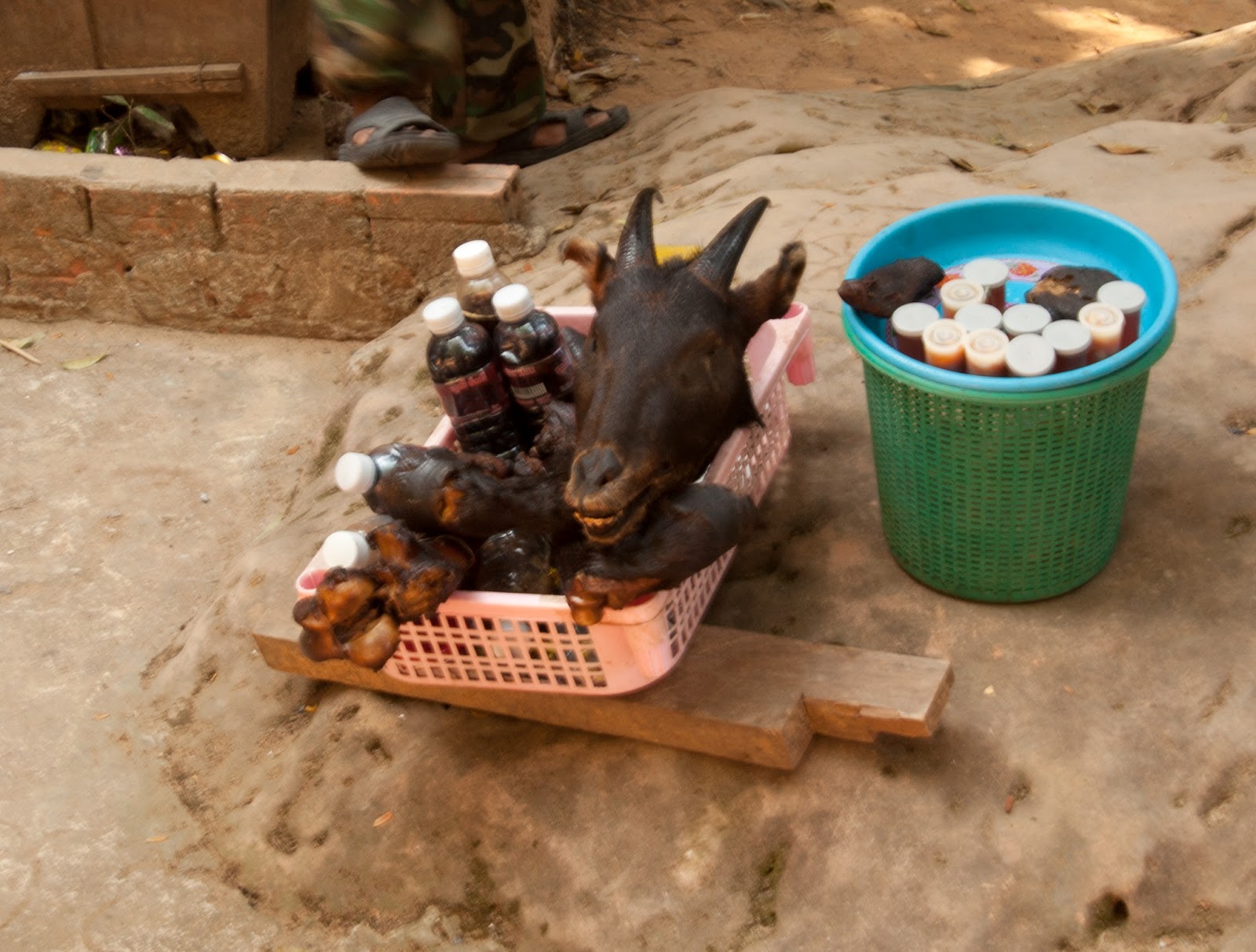
Prea Ang Tho features a giant reclining Buddha that rests atop a large boulder.  Unfortunately,  the only access is a steep, narrow stairway.  Since a line of worshippers  were waiting to ascend, we opted not to make the climb.  Instead, we admired the spectacular flowers, listened to musicians playing traditional instruments and browsed among the stalls filled with handicrafts and "medicinal" offerings, which often consisted of blood and body parts of forest animals.


Our next stop was a lovely waterfall that was obviously very popular with the local people.  All ages were enjoying the spot.  Young children and babies played in the swift stream in spite of the fact that only a few yards downstream the water rushed over another precipice to a pool 40 or so feet below!  But Cambodian children seem to have an instinct for self-preservation.  Not one came even close to tumbling over or had to be snatched away from disaster by a concerned parent.


Saturday, May 26, 2012

Angor Thom and Other Treasures

We entered another part of the complex through this massive carved gate.  As you can see, it was designed to accommodate elephants, not motor vehicles.  Buses can't pass through, and this van will have a tight squeeze of it.  John is proceeding on foot, keeping a sharp lookout for traffic.

And speaking of elephants, we saw several while we were in Angkor Thom.  Like their ancient relatives pictured in many of the exquisite carvings throughout the complex, they make their living carrying human cargo.  In this instance, however, it's tourists who are aboard, not warriors or Khmer royalty.  We were tempted to take a ride, but were packing all our photo equipment and decided to wait for another time. 


Built mostly during the reign of Jayavarman VII from 1181-1201, Angkor Thom was a fortified city that covered over 4 square miles and housed a million people or more.  Now designated as a UNESCO World Heritage site, restoration of the temples by the French began in the early 20th century.  It continues today under the auspices of the United Nations.  Not only did we see massive structures in all stages of excavation and renovation, we also saw some of the processes by which they were first created.  This is a demonstration of the process by which stones were lifted into place and aligned to form a structurally-sound unit.  This was necessary because the temples are not held together by mortar....just massive stones carefully placed to create buildings which would stand for centuries. 


Since many of the carvings that adorned the temples have been damaged or destroyed, workers are creating new ones.  This man was duplicating existing carvings using tools similar to the ones which sculpted the originals.  

We moved on to tour The Bayon, a temple built during the 12th century, which is located in the center of the Angkor Thom complex. The Bayon is mammoth, featuring 200 faces of Avalokitesvara carved on its 54 towers. The following images are from that temple.


The Bayon offers a number of popular photo-op spots where one can appear to be touching noses with one of the carved faces, as Jimmy Joe does here.


Perhaps my favorite temple was Ta Prohm. Erected late in the 12th century and early 13th century by Jayavarman VII, it was a Mahayana Buddhist temple built to honor his family. Originally called Rajavihara or "royal temple," The temple's main image, representing the personification of wisdom, is modeled after his mother. 


After the Khmer empire fell in the 15th century, this site was abandoned and neglected for hundreds of years. Rediscovered in the 19th century it had been to a large extent reclaimed by Cambodia's rainforest.   If some of these images look familiar, you may have seen them in the movies. We were told that scenes from the movie Tomb Raider were shot at Ta Prohm.

As with all the sites we viewed, we shared the experience with many other visitors.  Here Nine and our guide take a break while waiting to enter one of the buildings.

Much of Ta Prohm is still in ruins today. When it was discovered, the decision was made to leave it largely as it was found. However, many of the structures have been partially restored, to permit access and stabilize the ruins. 


Fortunately, some have been left at least partly in the grasp of the magnificent trees that grew up through and around them.  These trees are of several types, but the largest are said to be silk-cotton trees and the smaller ones are strangler figs.  (A most appropriate name in my opinion!)


The one below looks like a woman standing on her head with her long hair cascading over the wall.


Jimmy and I shot most of our images using our "Stedi-Stock" camera support systems. Mounted on a rifle-like stock, our cameras were much more stable than if we had simply hand-held them. This was a great advantage where it was difficult to use a tripod to get sharp photos.


At the end of the day, we were four tired puppies! Here John and Nine wait while patiently Jimmy and I take "just one more shot."


Sunday, May 13, 2012

Angkor Wat

While in Siem Reap, we stayed at the lovely New Angkorland Hotel

Our visit didn't start well. When we arrived, the desk clerk informed us that they were overbooked and that they had arranged for us to stay in another hotel. John and Jimmy took a quick look at the proposed accom-modations and promptly vetoed that plan.

In the meantime, Nine called her relative who had recommended the New Angkorland and who knew the owner. In about half an hour, we had rooms as originally promised. The next day, John and I (who were staying in what must have been the hotel's overflow room) were moved to a nicer room. We had a lovely stay there and enjoyed a trip to their spa for a massage as well.


Cambodia is roughly the size of Missouri, and has a colorful and chaotic history. Its population is said to be one of Southeast Asia's most homogeneous, with over 90% of the people being Khmers (ethnic Cambodians). Our guide book tells us that from the first to the sixth centuries, much of what is now Cambodia was part of the Funan Kingdom. In the early days, Funan accepted the Hindu religion. In spite of the fact that most of the people now follow Theravada Buddhism, there are many evidences of Hindu influence, especially in the area around Angkor where the first Cambodian empire was based.

During the 11th and 12th centuries, the Khmer empire conquered Burma, Vietnam, Laos, and Malaysia. It was a powerful nation and was recognized for its achievements in art and architecture (such as the temples at Angkor Wat), as well as an innovative irrigation system which allowed a large number of people to occupy a relatively small area.

We had come to Siem Reap so that we could visit Angkor Wat and the adjacent temples that were built during this time. Angkor Wat, the "city temple," was built in the late 12th century as a funerary temple and to honor the Hindu god Vishnu. It is the largest of the temples at Angkor.

Jimmy and I rose early in order to be at the temple complex to photograph the towers at sunrise. Accompanied by a guide, after a short tuk-tuk ride we entered the temple complex in full darkness and navigated the grounds by flashlight. However, as early as we were, we were not the first to arrive. The primo spot for photography is directly in front of the temple complex, looking across a reflecting pool toward the rising sun. I don't know how many others were there for the daily ritual, but by sunrise there was quite a crowd, as you can see. 

Fortunately or unfortunately, the grounds open every day before sunrise, so there is no real opportunity to get a private tour or special entry. Even staking out a great spot is no guarantee someone with a cell phone or point-and-shoot camera won't step out in front of you and spoil the shot.

We did get some lovely images, however. The sun rose in a clear sky, with just enough clouds to make it interesting. It was a great start to our day.


Jimmy and I saw plenty to marvel at, and to photograph.  Here he is, resting in the shade of a temple doorway.


John and Nine joined us a little later in the morning for a tour of the main Angkor complex.  They are in the background, with our guide, near the gate leading to another part of the complex.


The temple complex is vast, with a number of buildings. Below is a shot of the main gate seen from inside the complex.


This building stands apart, and we are told was a library.


All the structures are intricately carved. Battle scenes such as these cover many of the walls.


A number of the buildings feature carvings of female dancing girls known as Apsaras. These are figures from Hindu mythology, and there are said to be some 1,800 of them in the Angkor Wat temple. These are within reach of visitors, and their breasts have been rubbed to a sheen by many hands.


We prowled among the ruins, up and down the corridors,


and through the rooms and courtyards.


The monks were holding an audience in one of the alcoves.


Our day was far from done, however, and after lunch we moved on to see more.