Wednesday, September 15, 2010

Monuments and Memorials

This area is filled with history.....memorials....monuments, and many relics from our Nation's past. Even though we'll be here for an entire month, we can't hope to see and do everything. We have, however, visited several places we would like to share. Hopefuly more will follow before we leave this place.

The Black Hills, Pa Sapa in the Lakota Sioux language, means Place of the Black Cedars. From a distance, the hills do look black because of the dark green foliage of the Ponderosa Pine forests that cover their slopes. This was a region sacred to the native peoples. One of the memorials we visited was the work-in-progress, which is the sculpture of Crazy Horse, a warrior of the Oglala Sioux tribe who has come to embody the indomitable spirit of the Plains Indians.


Begun in 1948 by Sculptor Korczak Ziolkowski at the request of elders of the Plains Indian tribes, when completed the Crazy Horse Memorial will be the world's largest sculpture. It is being carved, and has been for the last fifty-plus years, out of Thunderhead Mountain just outside Custer, SD. The sculptor died several years ago, but the work is being carried on by his widow and by seven of his ten children. We were told that twice the family has been offered funding from the US Government which could amount to grants of $10,000,000 each. The sculptor and his family rejected the offers, believing that the work would be compromised or possibly not finished. Instead, they continue their work funded by donations, and by entrance fees to the monument and the excellent museum that occupies the grounds.

The image above is the statue as it exists today. The arm of Crazy Horse will stretch almost the length of a football field. Each year, there is more progress, though it is likely to be a number of years until the sculpture is finished. Below is a 1/34 scale model of the memorial as it will look upon completion.  If you are in the area, it is a not-to-be-missed attraction.


There are a number of excellent biographies covering the life of Crazy Horse from his birth, somewhere around 1840, until his death in September of 1877. If you are interested, I recommend the excellent biography, Crazy Horse, A Life, written by Larry McMurtry and published in 1999 .  I found it a fascinating read, and a good synopsis of the life and times of this Native American hero.
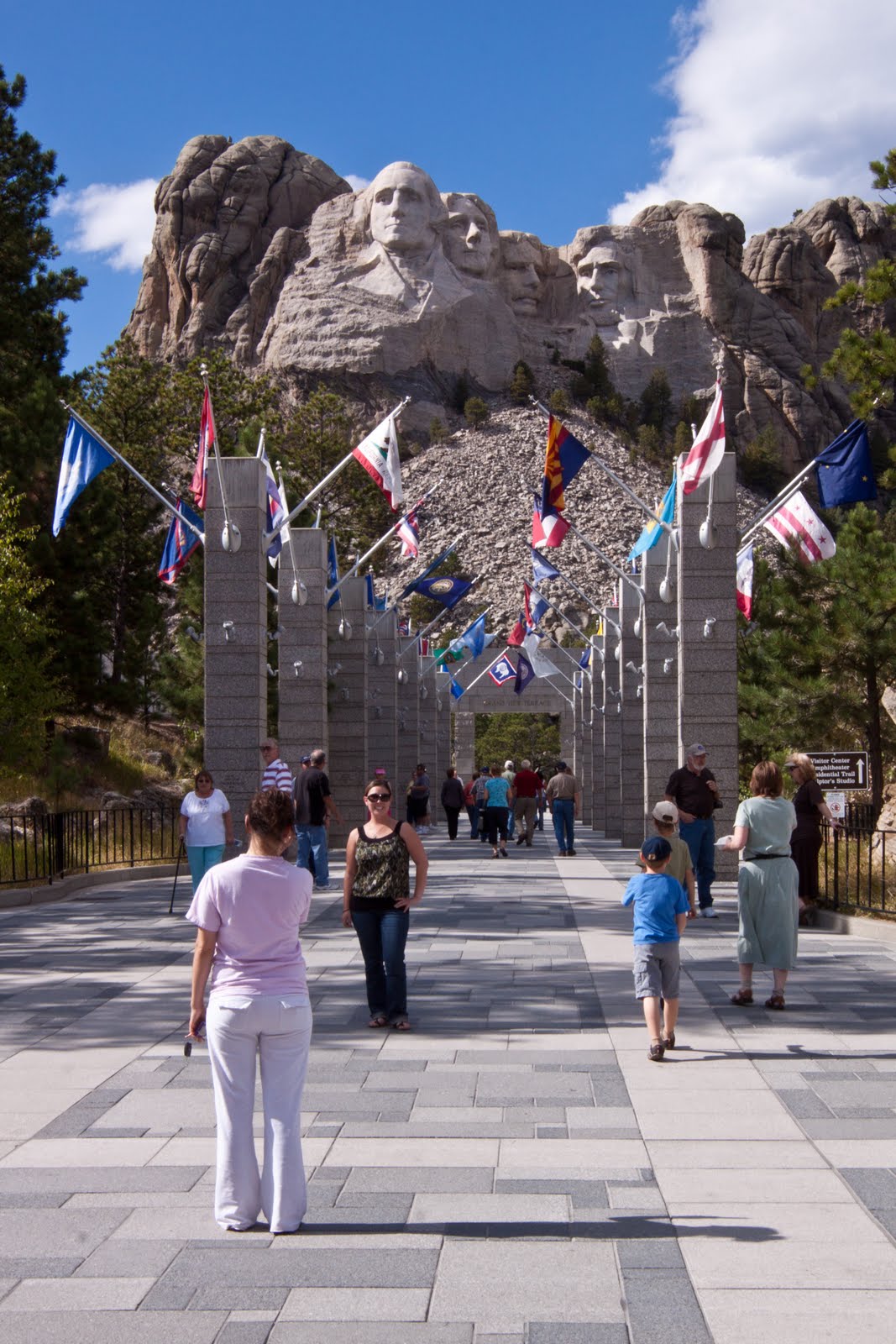

The granite cliffs of the Black Hills provide the setting for another sculpture, even more famous and revered. The Mount Rushmore National Memorial is just out Keystone, SD. President Calvin Coolidge dedicated the memorial in 1927, beginning fourteen years of work, only six of which were spent on actual carving. Renowned sculptor Gutzon Borglum was chosen to design and supervise the carving. He chose George Washington, Thomas Jefferson, Abraham Lincoln and Theodore Roosevelt as presidents to represent the first 150 years of US history. His goal was to embody "the formal rendinging of the philosophy of our government into granite on a mountain peak."

Honored on Mount Rushmore are the four leaders who brought the nation from colonial times into the 1900s. Washington is most prominent, commander of the Revolutionary army and first president of the United States. Next is Thomas Jefferson, included as the principal author of the Declaration of Independence and driving force behind the Louisiana Purchase, which virtually doubled the size of the nation. Abraham Lincoln held the Union together following the Civil War and ended slavery in the US. Theodore Roosevelt, the nation's 26th president, promoted construction of the Panama canal and championed conservation and economic reform.


It is interesting that the design of Mount Rushmore chaged several times because the granite didn't always prove stable enough to place the faces where originally conceived. Here are several views of the memorial. Some are taken within the park, and others from various vantage points outside the memorial. There is an evening lighting ceremony at the memorial which we hope to attend before we leave the area.


Saturday, September 11, 2010

Tatanka

Tatanka is the Lakota Indian word for Buffalo, or Bison bison. There are a lot of them in Custer State Park, some 1300 to be exact. We saw a number of bison yesterday as we drove the Wildlife Loop in CSP. The herds mostly ignore the cars driving through their range and stopping for a better look. We were warned, however, not to approach them. The bulls can be especially unpredictable during the rut, which is just ending. This bull and his lady friend were cuddling apart from the rest of the herd, while the big fellow in the other photo was strolling among his harem. They will be rounded up at the end of this month and sold to reduce the herd to some 930 animals. Since the park does not feed the bison over the winter, it is necessary for the herd to be culled each year so it will not exceed the carrying capacity of the park.


Bison are everywhere in Custer City as well as in the park. The town has on display a number of Tatanka like these decorated by local artists, many of Native American descent. They will be auctioned off the end of this month, so we could possibly bring one home to display at the farm. Transport home might be a bit of a problem, though!


We saw a lot more than bison on our drive, however. A herd of "wild" donkeys make their home at CSP. We were told they are the descendants of donkeys once used to carry tourists to the top of Mt. Harney, the tallest peak in South Dakota. When the donkey rides were discontinued, the donkeys were turned loose to fend for themselves. They are doing quite well, and are very friendly. One lovely lady donkey tried to give John a kiss through the car window, and this fuzzy young fellow was quick to come up to have his ears scratched.


The pronghorn antelope in the park aren't quite so friendly, but you can approach them in the car as they graze by the side of the road. This handsome fellow and his herd were quite unconcerned until Lucky Dog and Nickie got excited and started barking madly and begging us to let them out for a chase. I guess they looked like the deer the dogs see almost every day when we take our walk on the forest trails near camp (and which they do chase)!


We also saw quite a "herd" of turkeys grazing almost alongside the pronghorns. Here you can just see them in the tall grass between the road the antelope.


Thursday, September 9, 2010

That's Why They Call it Fishing

Weather here in Custer has been exhiliarating.....40s at night; high, gusty winds that bite right through you; 60s and 70s in the daytime with a crystal clear blue sky. Tuesday we went fishing, and I can brag that I caught the first, the last and the biggest trout. Unfortunately, it was the only trout. Lucky Dog and Nickie are proving to be real troopers when it comes to fishing. Nickie usually runs back and forth between John and me to be sure she doesn't miss anything. L.D. likes to lie near the trail in case someone comes by and needs to pet a dog. Here the two of them take a break to watch a squirrel in one of the pine trees.


We have been taking long walks and exploring the woods near the camp. There are over 100 miles of trails through the National Forest adjacent to the camp, so we have plenty of places to explore. Nickie and Lucky Dog have found squirrels to chase, not to mention deer (there are white-tails here, as well as mule deer). There are also flocks of wild turkeys that love to visit the horse corrals. I'm not sure you can call them truly wild, but the dogs find them great fun to chase.


Tuesday we said goodbye to our friends, Richard "Ski" and Nanci Skorski and four-legged friend Sable. We hope to see the Skorskis later this fall when they pass through Texas on their way home to Florida.


Tuesday night was right out of the 60s.....a "Duck and Cover" night. John was making dinner and I was working on the blog when there was a loud "Whump." When we investigated, we found that the spaghetti squash which was cooking in the microwave had exploded, in spite of the fact that John had pricked the skin as instructed. Oh, well, the next time we'll make the pricks deeper!


We got another chance at fish yesterday, but I guess they were still spooked from the weekend. I did hook a nice rainbow in Horsethief Lake, but Nickie was helping me land it and in the excitement the fish got away. We did see some pretty country, though. Here are photos of Sylvan Lake and Lavon Lake. Hopefully next time we visit the fish will be biting.

Monday, September 6, 2010

A Short Life, Well Lived

As many of you already know, on Thursday of last week we lost our beautiful Feathers. As the last light faded from the South Dakota skies, she lost her valiant three-month struggle to overcome Canine Meningitis and Megaesophogus, and the fast-acting pneumonia that resulted from the latter. We take some comfort that when she closed her lovely golden eyes for the last time, she was with John and me, Nickie and Lucky Dog, and that she knew she was loved and will be sorely missed. When we return, her ashes will be buried at the farm where she came to us only four short years ago. She made such a difference in our lives and will always be with us in spirit.


This post is very hard for me to write. I don't have the words right now to do justice to Feathers or to what she meant to us, Lucky Dog and Nickie included. For now, I would just like to share some of our favorite images taken over the last four years. Maybe in some way her spirit will shine through and you will know what a special friend she was.


June 18, 2006
July 25, 2006
November 17, 2006

November 17, 2006


March 31, 2007


November 5, 2008

August 4, 2009


August 27, 2009


February 1, 2010


April 10, 2010


September 1, 2010

Sunday, August 29, 2010

South Dakota


We enjoyed the trip north from Thedford, especially the many small wetland areas. In a few weeks when the fall migration begins, I imagine most of them will be covered with ducks, geese and maybe sandhill cranes.


We had planned to spend several days in the area around Valentine, Nebraska. That area contains Nebraska's tallest waterfall, Smith Falls; the Niobrara National Scenic River, known for its reliable water levels and good conoeing; and several wildlife refuges. Unfortunately, temperatures in the high 90s, with strong, gusty winds and blowing dust made outdoor activities unappealing. We decided to move on and return to Valentine another time.

Traveling west along Nebraska's Bridges to Buttes Byway, we saw more cattle, corn, and some amazing fields of giant sunflowers.


We stopped just outside Chadron to visit the Museum of the Fur Trade. Located on the site of a trading post operated by the American Fur Company from 1837 to 1876, the museum preserves the history of the fur trade from the Arctic to the American Southwest. Exhibits include not only trade goods and other rare artifacts, but an extensive collection of firearms used by trappers, buffalo hunters, mountain men and Indians. The restored trading post and exhibits are well worth a visit.

Turning north again at Chadron, we continued across the plains of southern South Dakota, through Hot Springs and into the Black Hills around Custer.


We are camped at Broken Arrow RV Park and Horse Camp 6 miles outside Custer. The camp has covered corrals, and backs up to the National Forest, where over 100 miles of trails are available. It is a popular destination not only for RVers, but for people who want to camp and have access to good riding trails. Here a group of riders wash down their horses after a 15-mile ride.


The Bagley Pack is learning that it's not cool to bark at horses, and that we move off the trail when we meet them. Feathers is enjoying herself, and in this cool weather is able to take a couple of good walks each day. Here, the dogs relax in front of the RV in the cool afternoon, and Feathers and Nickie share a bed in the rig.


Saturday, August 28, 2010

The Nebraska Sandhills

From Grand Island, we traveled into the Nebraska Sandhills to Anselmo, and camped at the Victoria Springs State Recreation Area. We loved the park, because there are no concrete or gravel parking pads. Instead, campers just pull into a site any way that works for them. Here we are, parked on the grass (and hoping that it doesn't rain!) If it does, we might be here for several days!

Victoria Springs is a 60-acre park covered with soft grass and stately cottonwood trees. It is named for the mineral springs located there, which, at the turn of the century drew hundreds of people who visited the springs and the spas that grew up there for the "medicinal properties" of the waters.


Two beautiful log cabins are still located in the park. They were built by Custer County Judge Charles R. Mathews, who settled there in the 1870s when the community was known as New Helena. One was his home, and the other served as the post office.  Judge Mathews was originally from Virginia, and he designed the cabins so the doors face each other because of his southern upbringing.


Anselmo is a small farming community of some 189 people. However, it does have a magnificent Catholic Church, St. Anselm's, built in 1929. The interior features several lovely pieces of statuary.


The area going into the sandhills is primarily agricultural. Corn stands at least 8 feet high, and irrigated beans and alfalfa are plentiful. However, once into the 19,000 square miles that make up this unique habitat, grasses predominate.


We traveled a section of Nebraska Highway 2 (the Sandhills Scenic Byway), and then turned north toward Valentine on Highway 83. We were amazed by the area. The Sandhills make up the largest tract of stabilized sand dunes in the Western Hemisphere. The rolling hills are covered with a sea of waving grass. In the valleys (some only a few acres) and along the rivers, the grasses have been cut and baled for winter feed. In the bottoms of other small valleys are miniature lakes and wetlands fed by the Oglalla Aquifer.


We were amused at the size of the windmills in the Sandhills. The groundwater is so close to the surface here that windmills aren't tall and stately like those in Texas. Instead, they're short and squatty...some only 12 feet or so tall.


Railroad tracks run alongside the road for most of the section between Anselmo and Thedford, where we turned north.  We saw many trains, most going east loaded with coal from Wyoming or returning for another load.  The trains were often 100 or more cars long, and had two engines pulling and one pushing.  They are often no more than 15 minutes apart, so the small town residents are treated to frequent train whistles as they approach the crossings.  (Fortunately we camped far from the tracks in Anselmo rather than in Broken Bow where the RV park is right alongside the rails!)